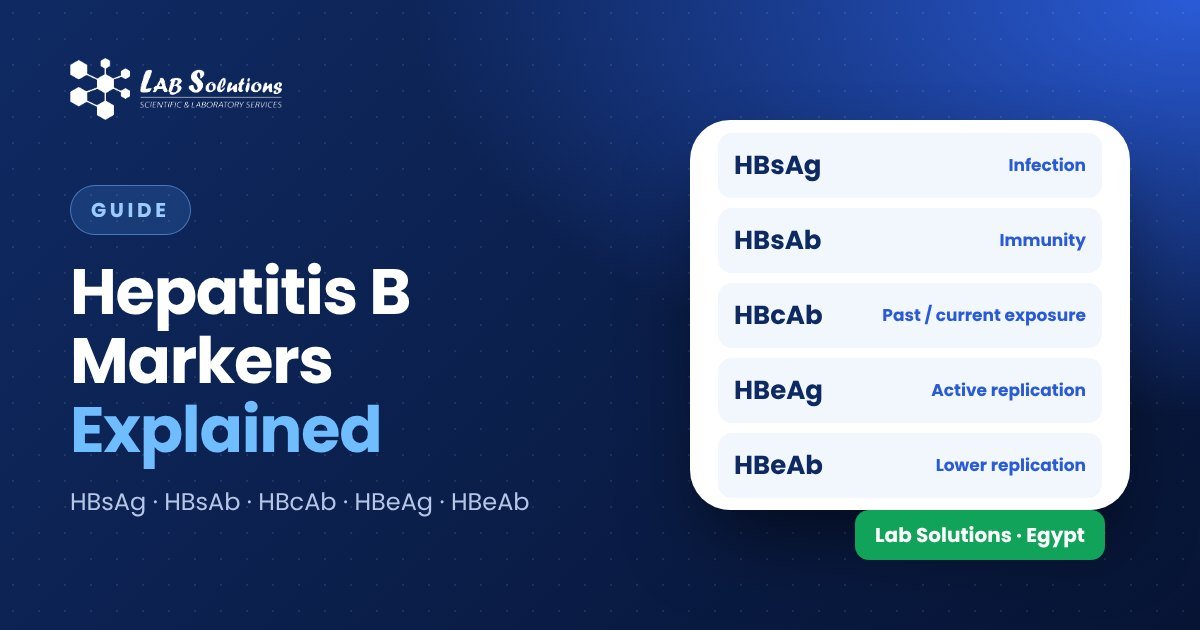
Hepatitis B testing uses several markers — HBsAg, HBsAb, HBcAb, HBeAg and HBeAb. Each one answers a different question: Is there an active infection? Is the person immune? Was the infection in the past? This guide explains what each marker means and how to read the most common result combinations.
The hepatitis B markers explained
- HBsAg (Hepatitis B surface antigen): a protein on the surface of the virus. A positive result means the person currently has hepatitis B infection — acute or chronic — and can transmit it. HBsAg rapid test
- HBsAb / Anti-HBs (surface antibody): shows immunity, either from vaccination or from recovery after a past infection. HBsAb rapid test
- HBcAb / Anti-HBc (core antibody): appears after contact with the virus (not after vaccination). It indicates a current or past infection. HBcAb rapid test
- HBeAg (e-antigen): a marker of active viral replication — usually a higher viral load and higher infectivity. HBeAg rapid test
- HBeAb / Anti-HBe (e-antibody): usually indicates lower viral replication and lower infectivity. HBeAb rapid test
How to interpret common result patterns
- HBsAg negative, HBsAb negative, HBcAb negative: never infected and not immune — vaccination is recommended.
- HBsAg negative, HBsAb positive, HBcAb negative: immune due to vaccination.
- HBsAg negative, HBsAb positive, HBcAb positive: immune due to a past, resolved infection.
- HBsAg positive, HBcAb positive, HBsAb negative: current infection (acute or chronic). Further tests such as HBcAb IgM, HBeAg and HBV DNA help determine the stage.
- HBsAg positive with HBeAg positive: active replication and high infectivity.
- HBsAg positive with HBeAb positive: usually lower replication — follow-up is still required.
Results must always be interpreted by a physician together with liver function tests and the patient's history.
What is the "Hepatitis B combo" test?
A hepatitis B combo or profile test checks several markers — typically HBsAg, HBsAb, HBeAg, HBeAb and HBcAb — on one device from a single sample. It gives a fast overview of infection and immunity status, which is useful for screening programs, blood banks and pre-surgery checks.
When are rapid tests used?
- Pre-employment, pre-marital and pre-travel screening.
- Pre-operative and pre-dialysis screening.
- Screening during pregnancy.
- Checking immunity after vaccination.
Rapid tests give results in minutes from serum, plasma or whole blood (depending on the test). Positive screening results should be confirmed with laboratory methods such as ELISA/CLIA and HBV DNA PCR.
Lab Solutions supplies RightSign hepatitis rapid tests to laboratories, hospitals and distributors across Egypt. Explore our infectious disease tests, including HCV and HAV, or request a quotation.